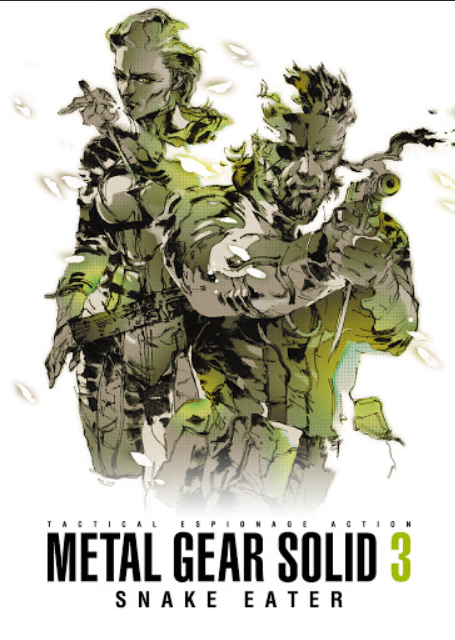
I know, I kept you waiting, huh? With the release of Metal Gear Solid 3: Delta Snake Eater on the immediate horizon we here at TaylorTalksEntertainment wanted to revisit the original game in preparation. It has been 21 years since the original release of Snake Eater, so let us take a look to see if it’s still worthy of all the praise this much time later. This is Metal Gear Solid 3: Snake Eater!
Introduction & Pre-Production
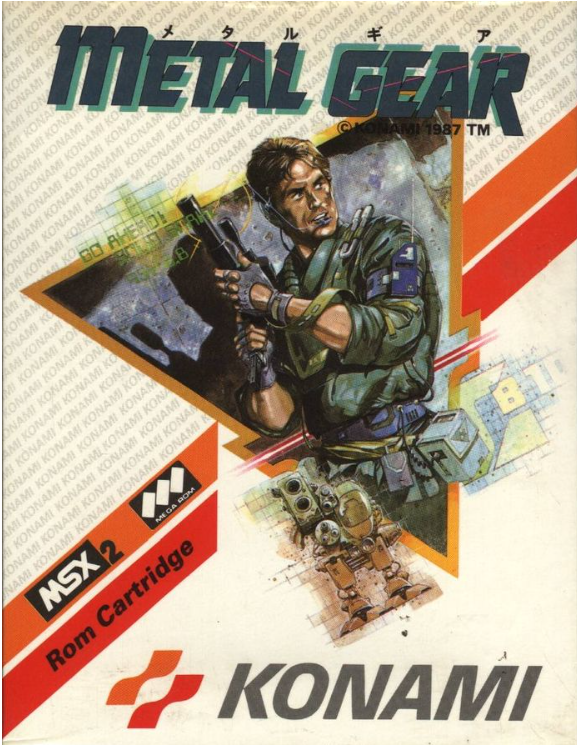
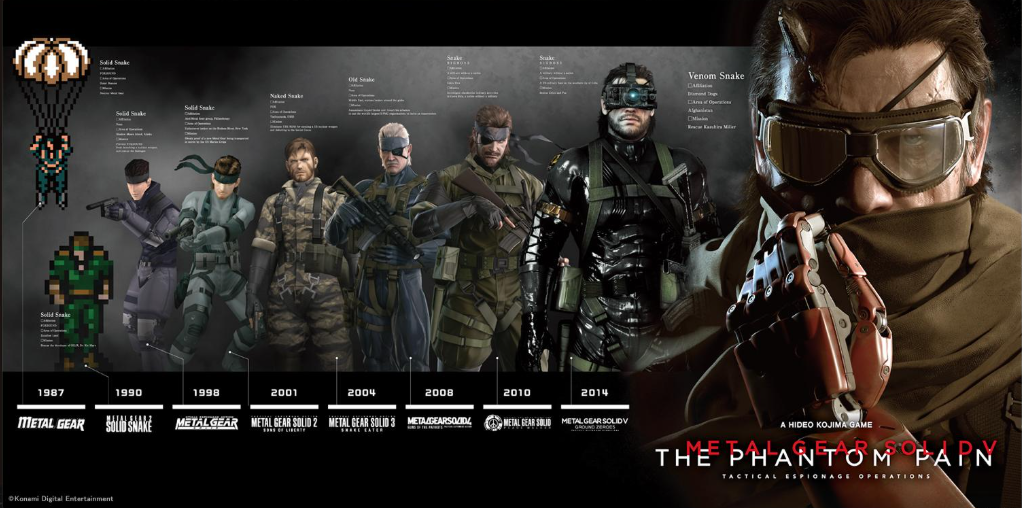
Seeing as this is the first time the team has covered the franchise of Metal Gear here on the site, a light history lesson may be in order for those who have never heard of Metal Gear. The series was the brainchild of one Hideo Kojima and published by Konami. The franchise has roots going all the way back to 1987 for the MSX2; a home computer system, which also doubled as one of the earliest gaming consoles for the average home.

Series Creator Hideo Kojima who sought to be a film director but shifted focus and used his projects to create interactive movies in the form of Video games, his debut title being a game titled Penguin Adventure..
Metal Gear in its conception was meant to be a title based around military combat, however the MSX had limitations during that era involving trouble loading too many character models at once so Kojima shifted focus and instead decided to base the game around stealth, avoiding combat altogether, a choice that was pivotal in establishing the stealth genre as many know it today.
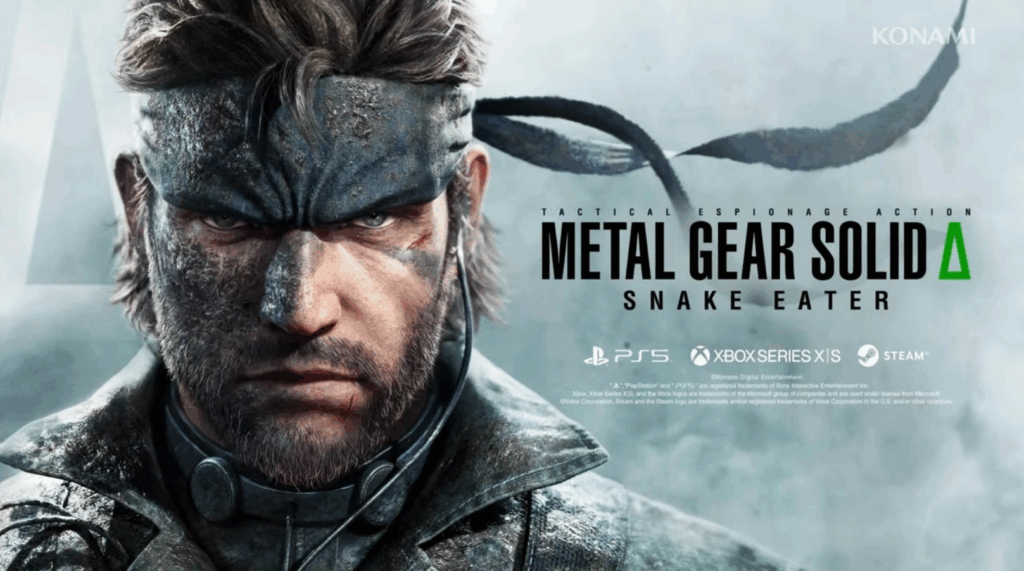
Between 1987 and 2015 the series saw the release of nine mainline installments, not including the likes of spin-offs, mobile tie-ins, and compilation titles. While the series entered a state of dormancy following the departure of Kojima after conflicts with series publisher Konami, it is poised to have a new installment in the form of the upcoming Snake Eater remake titled Metal Gear Solid Delta.
But let us turn the clock back to 2004, The likes of Metal Gear Solid 2: Sons of Liberty had released to financial and critical acclaim in the year 2001, however not without it’s controversy. Beyond the story content and the social, economic, and political commentary of said content, one of the largest criticisms stemmed from the narrative swerve that Sons of Liberty’s primary playable protagonist was not series regular Solid Snake but rather a brand new character, Raiden. At the time of release this was a point of contention internationally as much of the game’s marketing material went out of their way to avoid showing Raiden and focused entirely on Snake.
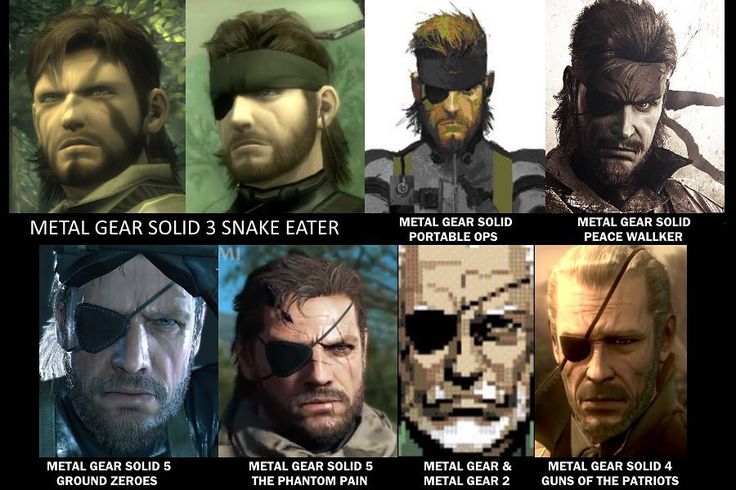
As a result Snake Eater had a lot of screen time showing various bits of gameplay and narrative material and was most insistent on showing that Snake would be the main attraction of the title. However, the likes of Metal Gear Solid 1 and 2 were set in the years of 2005 and 2007/2009 respectively. Snake Eater on the other hand is set at the height of the Cold War in 1964. The question was raised of how could we be playing as Snake when Solid Snake was a fresh recruit in the original Metal Gear set in 1995? The answer: Solid Snake, and his brothers Liquid and Solidus were all clones of one soldier in his prime and that soldier was none other than the legendary Big Boss, the primary antagonist of the original Metal Gear 1 and 2. Snake Eater was in fact going to be an origin story, not only for Big Boss but also for the series itself. This likely had many curious as to whether or not this was going to be focused on the man’s fall from grace, making it highly intriguing to long-time fans.
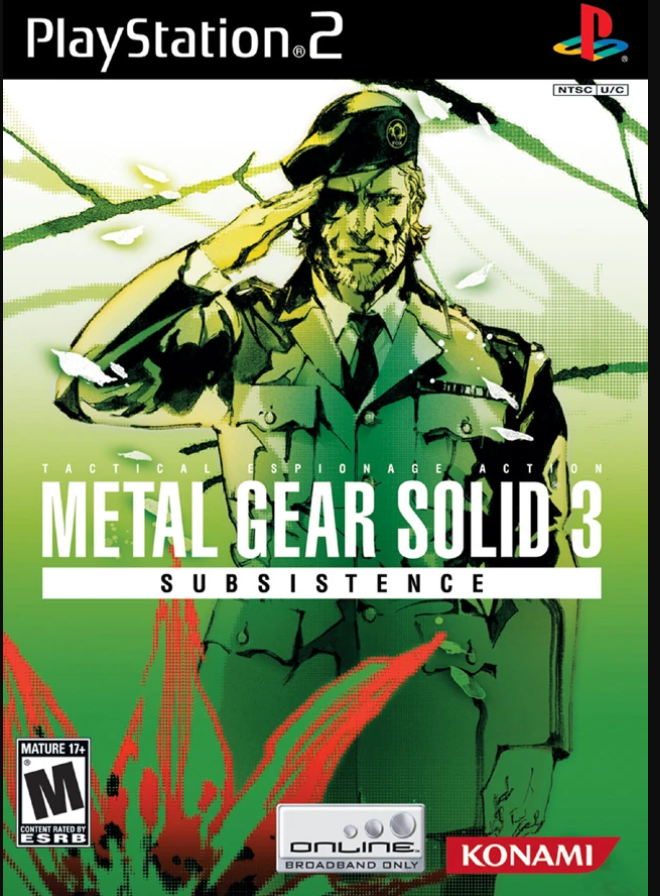
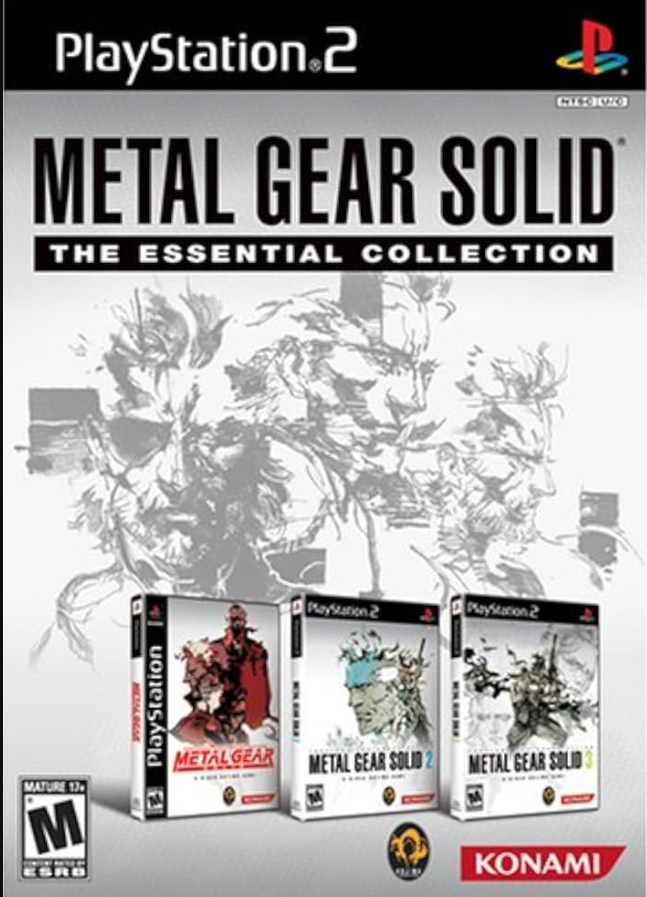
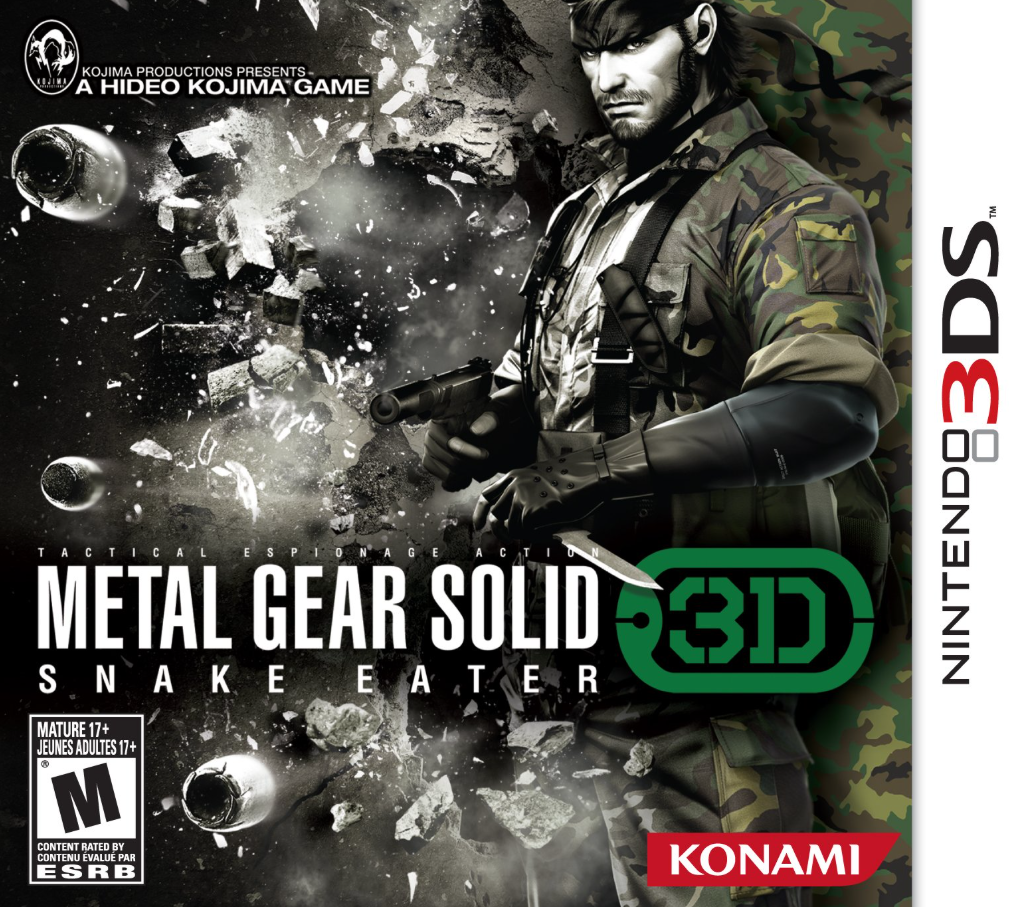
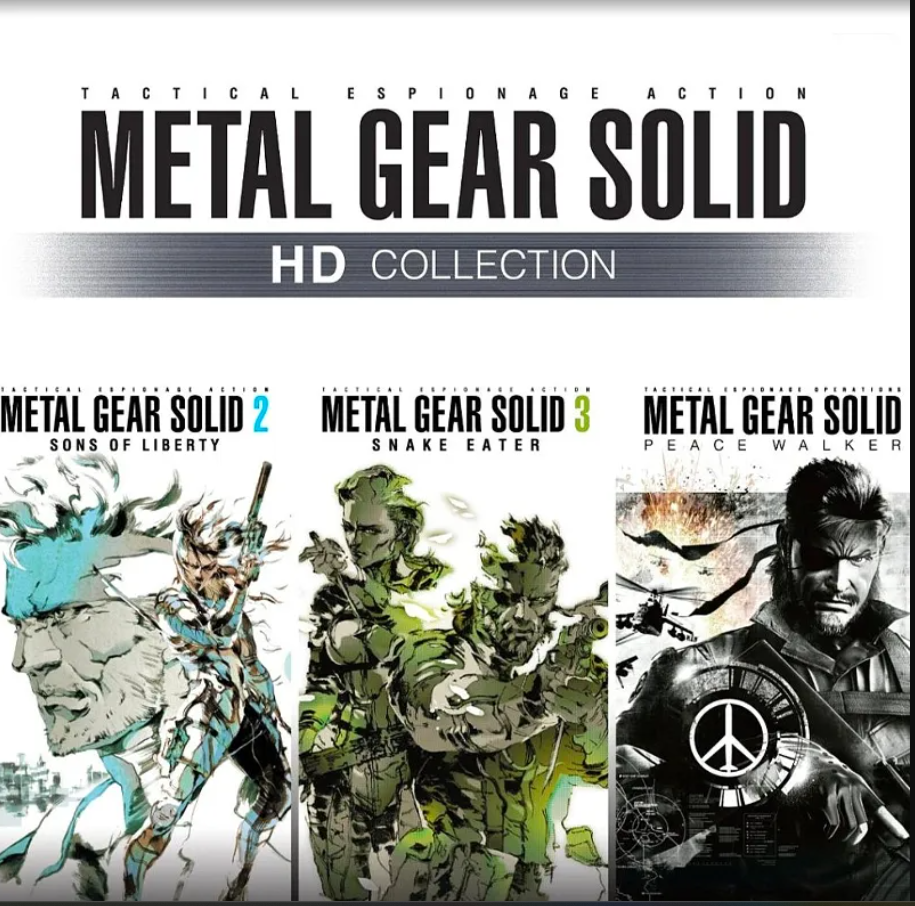
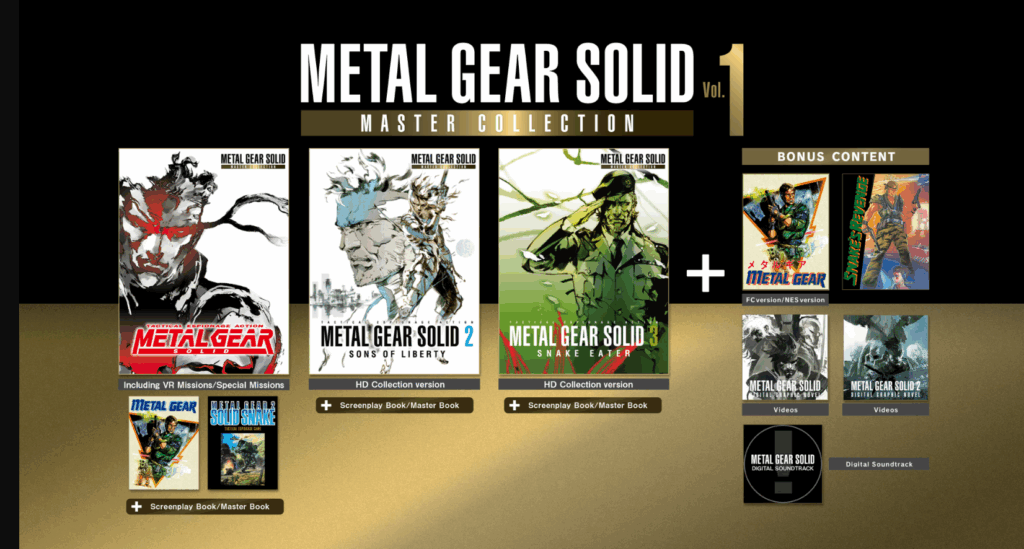
As series creator Hideo Kojima once again served as project director, producer, designer, and lead writer whilst Snake Eater was co-written by Tomokazu Fukushima and Shuyo Murata. Yoji Shinkawa returned once more to oversee the game’s art direction, Kazunobu Uehara was responsible for programming whilst the score was composed by returning talent in the form of Norihiko Hibino and Harry Gregson Williams. Snake Eater was originally released for PlayStation 2 in 2004, with the enhanced re-release Metal Gear Solid 3: Snake Eater Subsistence also releasing for the same console a year later as well being bundled in the PS2 only collection known as Metal Gear Solid: The Essential Collection. Snake Eater was also no stranger to re-releases as it saw a standalone release for Nintendo 3DS in 2012. The game also came to the likes of Xbox 360, PlayStation 3, Windows PC, Nintendo Switch, PlayStations 4 and 5, and Xbox Series X as part of the HD and Master Collections, compilations overseen by Bluepoint Studios.
Synopsis & Writing
Our story begins in 1964 above Soviet airspace with a covert operative codenamed Naked Snake preparing to perform the world’s first HALO jump in order to recover a Soviet rocket and a weapons scientist named Sokolov, who attempted to defect across the iron curtain but was forced to return to Russia following the Cuban Missile Crisis. What should be a simple extraction in enemy territory goes remarkably sideways when Snake’s mentor, a legendary female soldier known as the Boss, defects to the Soviet Union in order to help the Soviets develop a nuclear equipped battle tank capable of launching from any point in the world. That tank is the Shagohod. Snake’s initial mission is a failure and the only way to avoid nuclear all out war between the USA and USSR is to eliminate the Boss, destroy the Shagohod, and recover Sokolov. This is Operation Snake Eater..
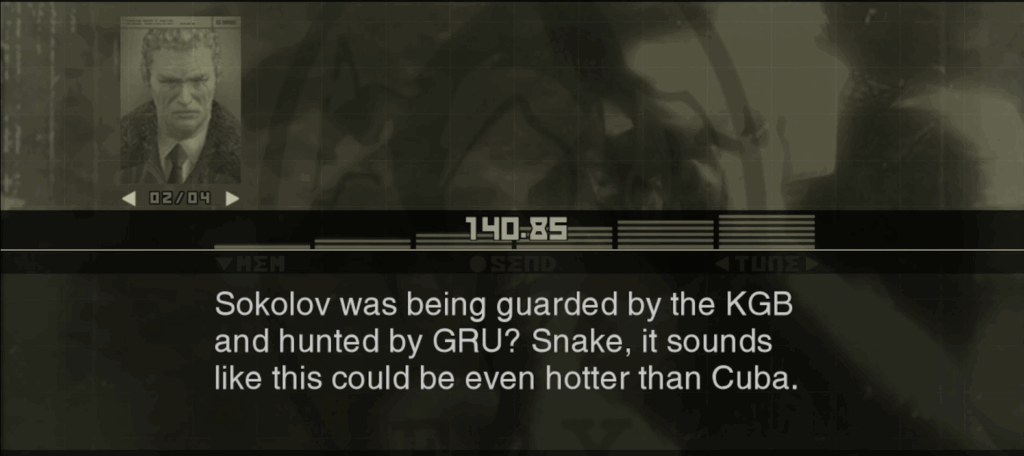
The story presents a very standard setup for Metal Gear of a single operative needing to infiltrate enemy territory and avert nuclear Armageddon and Snake Eater is no exception to that. That being said Snake won’t be completely alone in his mission as he has the members of the Fox Unit supporting him over radio, Major Zero, who largely provides background, narrative and progression advice, Paramedic, who is Fox’s resident medical expert who will advise you on how to treat wounds as well as inform on the floral and fauna Snake can consume in the area, among them is a man codenamed Sigint who will act as your go-to on any information you need regarding weaponry and technology, be it yours or the enemies, and lastly is EVA, a KGB spy planted in the ranks of GRU to support Snake on behalf of Kruschev who wishes to prevent the rise of the Breshnev faction, which will in turn prevent nuclear conflict.
The previous entry Sons of Liberty wasn’t devoid of character moments but its focus was largely bogged down in the story itself, whereas Snake Eater manages that balance much better as the Fox unit is relegated to support yes, but still have plenty of moments to establish character. And a strength of the radio codec calls largely being optional is that it is up to you as the player to decide how much of these calls to listen to. This method allows the developers to deliver characterization without having to dedicate cut scenes for this purpose.
On the subject of characterization, there are two characters I have yet to speak about, which would be Snake the man who would go on to be Big Boss as well as the young Spetsnaz officer, Ocelot who acts as a recurring rival and obstacle for Snake. Much care was given to the introduction, dynamic, and growth of these two. And while yes, Snake Eater is an origin for Big Boss, it is also an origin story of this character dynamic, which will be a driving force during the rest of the series, particularly in the next mainline game Guns of the Patriots. Ocelot is given more screen time in comparison to the likes of Metal Gear Solid 1 and 2 and that makes sense given the context and importance of Snake Eater’s narrative within the franchise. The same extends to Snake who feels much more grounded than his successor Solid Snake and I would wager that this is intentional as the writers wanted to make his perceived fall much more impactful by showing what made the man behind Outer Heaven what he is.
After the likes of Sons of Liberty which had much to say in terms of commentary including but not limited to; social engineering, censorship, existentialism, free will and much more. Snake Eater on the other hand wished to take a step back and write something more concise. One might not associate the cold war with simpler times, but in the context of Metal Gear this is a much simpler story than what preceded it and to be honest what came after it. The game also tells a complete story, there are a few threads the writers left open in case people wanted to follow up and check out the rest of the series. But that is natural given Snake Eater’s role as a prequel.
As much fun as Snake Eater’s story is and all the things it does well, it has uneven pacing much like the rest of the series. Excluding codec calls, the opening is about 15 minutes of gameplay and about an hour of cinematics. Following that the story is plentiful throughout but has much more gameplay story balance to go around. The pacing slows to a crawl around the endgame and makes up 2+ hours of the entire experience.
Gameplay
Snake Eater represented a large shift in how games in the series were designed and produced from a gameplay experience as nearly every game afterwards took notes from Snake Eater. To start with the simple stuff, MGS3 builds off the stealth action present in the likes of Solid and Sons of Liberty. The first major change that players will need to get acquainted with is the change in environment. Since the MSX games Metal Gear has largely been set in urban environments with certain exceptions. Players largely were infiltrating military bases, whereas Snake Eater spends most of its time with Snake sneaking through the jungle with only the occasional military facility, breaking up the experience. The developers also changed key functions of the franchise as the soliton radar of the past that gave you specific field of vision and patrol routes for enemies are gone. Snake Eater wants you to use your eyes and other senses. Set in the 1960s, the lack of certain end- all-be-all tech solutions makes sense as they wanted to immerse you in that era.
Among the major additions is the camouflage system, so throughout the game Snake will acquire various combat fatigues that allow him to blend in better with his environment and avoid enemy detection. Each camouflage has its own stats on the percentage of coverage they provide. The higher your camo index percentage, the more well-hidden you are and the harder it is for the enemy to detect you.
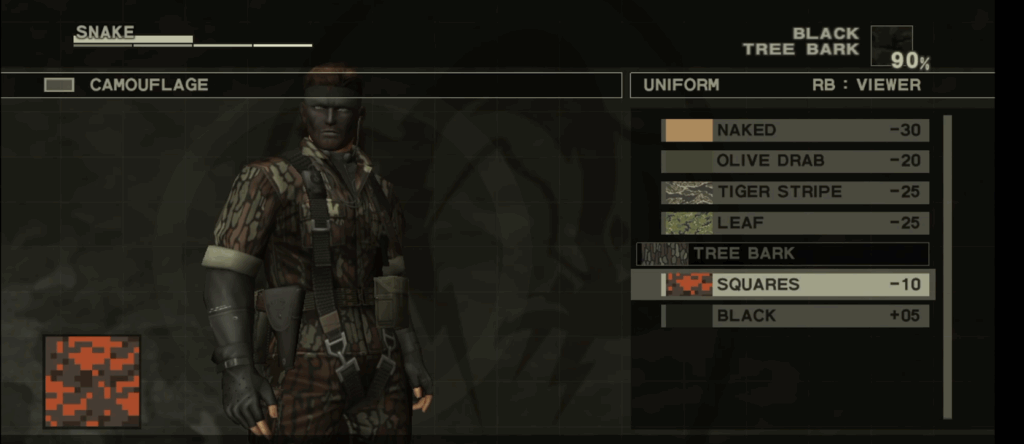
Some of these camos are well hidden and require exploration, often providing a unique perk as a reward for using said camo. The Subsistence release brought in some new camos that were available through the PS2, connecting to the internet. And the 3DS version allowed you to create custom camos through use of the 3DS’ photo camera feature, a nifty mechanic that breaks the balance as it was very easy to take photos that provided 100% coverage, making you essentially invisible to the enemy even if they were right on top of you.
The other major addition Snake Eater brings to the table is a much more fleshed out close quarters combat, or CQC for short. For context, previous games had a form of CQC but it was often a last resort that you didn’t want to partake in. Snake Eater brings a much more refined version of it to the table. So much so that it takes melee combat from a last resort to the cornerstone of Snake being able to deal with enemies silently. You can opt for something basic such as grabbing an enemy soldier and throwing him to the ground, instantly knocking him out. Other options include putting an enemy in a hold to interrogate them or bringing out a knife to lethally remove them from the battlefield. CQC radically changes enemy engagements and combines this with the fact that Snake Eater puts a strict limit on the amount of reinforcements during the alert phase, which means that through lethal or non-lethal means you can overcome the opposition if push comes to shove. The game will have certain commentary on whether or not you pursue lethal vs. non-lethal tactics in a creative sequence.
The pacing issues we previously touched upon in the narrative summary does unfortunately rear its head as there is one mechanic that while creative puts the brakes on the whole experience. That mechanic: the survival viewer. When players received injuries in previous games. treating them was as simple as using consumables such as rations or bandages to recover health or stop the bleeding. However, in Snake Eater when you receive a serious injury it will physically and permanently reduce your health bar until you go into the survival viewer to treat it with medical supplies. If you find yourself constantly getting in fights you’ll be going into the window constantly to treat your injuries. It is the most glaring of a pace killer during Boss fights.
However, repeatedly being heavily injured will in fact extend Snake’s health bar after healing from said injuries, which can be accelerated by having a lot of stamina. Snake Eater largely does away with consumable items for restoring health and instead has stamina taking its place, Snake’s health will passively recover when not in combat, the rate of which is determined by your stamina. The stamina gauge will drain over time but can be restored by consuming food you find in enemy supply stations or more commonly through consuming the flora and fauna Snake finds in the forest. The name Snake Eater is thematically relevant with the narrative yes, but it is also very literal.
Like human taste buds change, so will Snake’s. If he eats the same food repeatedly he will eventually come to like it more and more..
The modern gaming space of today puts an emphasis, or obsession one could argue, with hyper realistic physics and visual fidelity. But Snake Eater has many, many details in how its game systems operate, which is honestly still impressive today. For example, food you kill and capture will expire and rot over time based on your game system’s internal clock and will rot after one day of real time. This famously can be used to exploit a certain Boss as you can either kill him early or he will die of old age during the Boss fight if too much real time expires. Snake Eater is full of details like this that i could spend an entire article talking about that are honestly impressive even by today’s standards.
Conclusion
Even 20+ years after its release, Snake Eater holds a special place in the heart of fans and critics alike. The game is often brought up when discussing the most innovative games of all time, and is also among the highest selling games in the series. True masterpieces change their genre for the better and leave an impact that others aspire to. Snake Eater without a doubt falls within that category. As to whether or not the upcoming remake of this classic can live up to Snake Eater’s legacy, we have yet to see. I strongly recommend Snake Eater to fans of action games and those looking to get into the series!
Patron Shout-Out
Special thanks to our loyal Patreon supporters who support us week after week, from the bottom of our hearts, thank you:
Francesco
Lisa